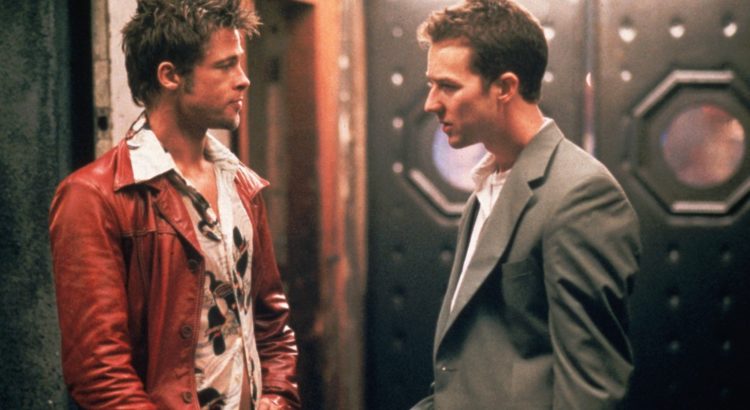
David Fincher’s Fight Club is one of my favourite films. However, I’m aware of the place the film occupies in the cultural consciousness as a text beloved for its depiction of a certain kind of masculinity – and above all, for its breakout character, Tyler Durden. In recent years, with the advent of the Internet, Tyler Durden has “become something of an unironic poster boy for Men’s Rights Activism” (Barnett n.p.). He has been co-opted and glorified by men’s rights movements, seen as a hero of misogyny and toxic masculinity. Since the idolisation of Tyler by these kinds of movements informs so much of the discussion around the film, I often wonder if I’ve interpreted it wrong, and if the film does endorse a form of toxic masculinity. But when I rewatch the film, I read it as a critique of toxic masculinity. By the end, Tyler has become a domestic terrorist, and the Narrator realises that he has to kill Tyler to free himself of his harmful ideology.
Is it the fault of the film, and Fincher as its director, that segments of its audience have interpreted it as a romanticisation of toxic masculinity and domestic terrorism? When considering this question, I thought about Roland Barthes’s essay “Death of the Author.” In the essay, Barthes argues against conflating an author with their text, and viewing them as the sole architect of that text, and as the only person who can interpret it. Barthes suggests that “remov[ing]” the author from the text will “transform” it – it will open up the possibilities of interpretation (145). He also writes that “[t]o give a text an Author is to impose a limit on that text, to furnish it with a final signified, to close the writing” (147). One of the joys of reading a text is interpreting and understanding it however we want, and possibly differently from those around us. But Barthes also argues for the absolution of the author. He believes that writing is a space “where all identity is lost, starting with the very identity of the body writing” (142). If this is true, then an author cannot be held accountable for what they write, and the negative impact their work may have. If the work is entirely in the hands of the reader, and the author is a blank slate who is “born simultaneously with the text”, then does the author bear any responsibility for how their work may be received? (145) In the case of Fight Club, is Fincher responsible for the popular interpretation of the film and the character of Tyler Durden? If we remove Fincher as author from the equation, “the text is henceforth made and read in such a way that at all its levels the author is absent” (Barthes 145). But Fincher’s absence from the text is also the absence of any intention in creating the text – why does it exist? Where did it come from? Texts don’t just appear out of nowhere; people with certain worldviews and biases create them. To read a text in such a way that the author is completely absent is to absolve them of any prejudices or ill intentions in writing the text.
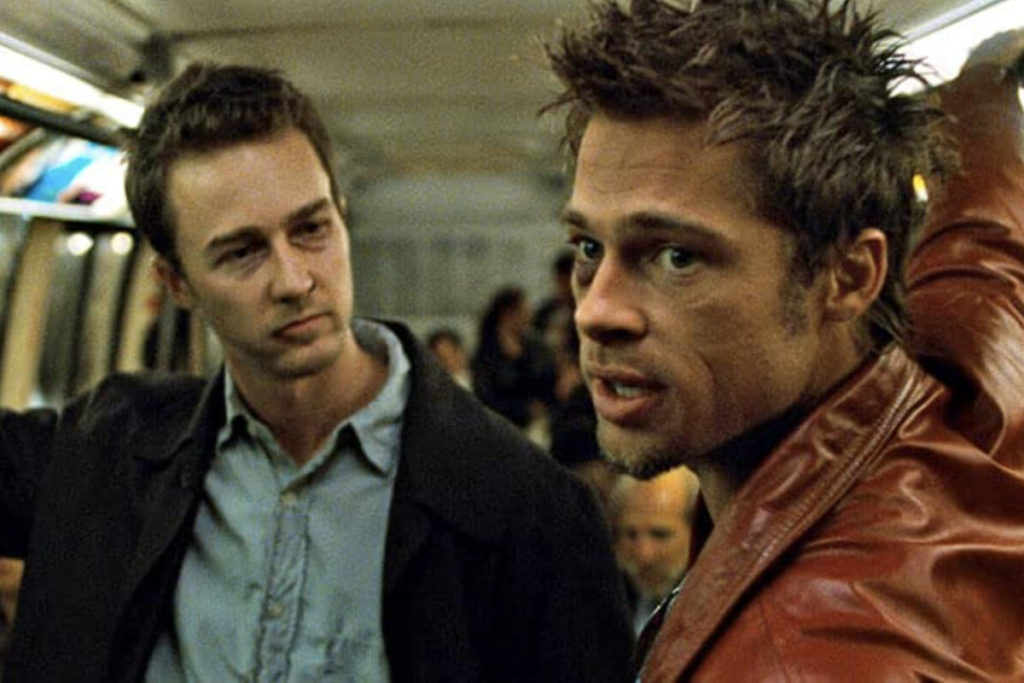
When I watch Fight Club, it seems obvious to me that it’s a satire of both consumerism and toxic masculinity. Is it Fincher’s fault that the film has been co-opted by viewers who disregard its satirical nature? For a film to be an effective satire, should it be completely clear to all audiences that it is in fact satirising its subject matter? I think that Fight Club is an effective satire of toxic masculinity; the fight club concept, and its rapid-fire spread across the United States by the end of the film, is absurd. The character of Tyler Durden is more complicated, though. David Barnett suggests that the casting of conventionally-attractive actor Brad Pitt as Tyler has contributed to the character’s glamourisation by its audience. Tyler is so charming that, for most of the film, it’s easy to overlook some of his immoral actions. But that’s the point of the character – he’s so charismatic and engaging that he enrols many young men into his cult of toxic masculinity and domestic terrorism, and it’s only when he’s about to blow up a bank that the Narrator realises how dangerous he is. Laurie Penny writes, however, that the film itself gets caught up in Tyler’s charm and “has so much fun with Tyler Durden as a mad phantom from the id that it forgets that he’s meant to be frightening” (qtd. Barnett n.p.). This is one of the dilemmas of Fight Club: the more captivating Tyler is, the more entertaining the film; but the more captivating he is, the more viewers will be drawn to him, and the likelier they are to overlook the purpose of his character and idolise him. But, again: is that the film’s fault? Should it consign itself to creating a less interesting character to avoid the possibility of its misinterpretation?
This last question raises an even bigger question: is there such a thing as misinterpretation? Does a text have one true meaning? If so, then the author must have created this one true meaning, which means that a reader cannot interpret it for themselves. But even if there is no true meaning, and multiple interpretations are possible, can there be an incorrect interpretation of a text? In “Death of the Author”, Barthes creates an image of an ideal reader who can hold all possible interpretations in their head; he writes that “the reader is without history, biography, psychology; he is simply that someone who holds together in a single field all the traces by which the written text is constituted” (148). However, just as the author is not without identity, neither is the reader. Like the author, they bring their own viewpoints and biases to the text. They may interpret the text in a way the author never conceived of or intended. But ultimately, even if there are interpretations others may disagree with, there is no such thing as an incorrect interpretation, just as there is no correct one. The text is for the reader to interpret. Chuck Palahniuk, author of the novel Fight Club, says, “My policy has always been to not give a definite meaning or intention to my work or characters. That would preclude the reader’s participation” (qtd. Barnett n.p.). Rather than believing in the complete death of the author, I like to see texts as a collaboration between author and reader: each brings something to it, and each person is necessary for the text to exist.
To return to my original question: is it Fincher’s fault that Fight Club has been adopted by men’s rights activists? I don’t think so. Since a text can have any number of interpretations, an author can’t be held responsible for an interpretation of their text that they never imagined. However, I agree with Penny that in part, Fight Club invites the glorification of Tyler Durden because of the film’s own fascination with him. There are no easy answers. Even though I find certain views on the film unsettling, I’m confident in my own interpretation of it, and I have to be content with that.
Works Cited:
Barnett, David. “Is Fight Club’s Tyler Durden film’s most misunderstood man?” BBC, 23 Jul. 2019, https://www.bbc.com/culture/article/20190717-is-fight-clubs-tyler-durden-films-most-misunderstood-man. Accessed 15 Nov. 2023.
Barthes, Roland. “Death of the Author.” Image Music Text. Translated by Stephen Heath, Fontana Press, 1977, pp. 142-148.
Fight Club. Directed by David Fincher. 20th Century Fox, 1999.