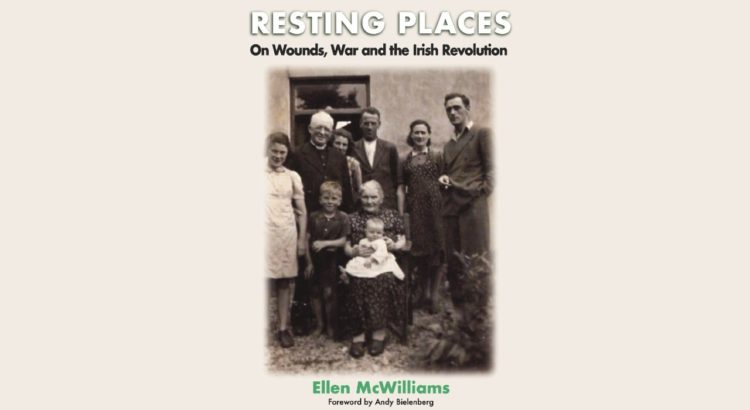
I recently attended a UCC research seminar given by Dr. Ellen McWilliams, in which she discussed her new book, Resting Places: On War, Wounds, and the Irish Revolution. Dr. McWilliams was introduced by Stephen Travers, a survivor of the 1975 Miami Showband Massacre. Travers’ presence at the seminar drew a connection between the history of the War of Independence and republicanism in the south of Ireland, and the Troubles, as he also did in the text of his introduction. He set the tone for the seminar by describing love as the driving force behind Resting Places. He spoke about the importance of knowing and understanding “where we come from” – the importance of talking about Irish history, rather than continuing to remain silent about it. This is crucial, because our recent past continues to affect our present. Travers noted the significance of the word “wounds” in the title of the book, and said that Resting Places “cleans the wounds” of the Irish fight for independence. Also present at the seminar were members of the Coffey family, whose relatives Timothy and James Coffey were murdered in 1921. Dr. McWilliams referred to the Coffey family throughout the seminar, citing their support of her in her writing of the book, and inviting them to answer some of the audience’s questions at the end of the seminar. I thought that their involvement in the seminar was evidence of how Resting Places “cleans the wounds” of the War of Independence – Dr. McWilliams gave them a platform to speak about the tragedy that still affects their family, and to share their thoughts on the Irish Revolution more generally.
In the seminar, Dr. Williams described Resting Places as exploring how the Irish Revolution still “haunts” the present. I found her use of words such as “ghosts” and phrases such as “rais[ing] the dead” very striking. I am always interested in stories about how the past informs and “haunts” the present. This is such an appealing theme in literature because it is true to life. As Resting Places examines, the violence perpetrated during the War of Independence and Civil War scarred those who lived through it, and those scars live on in their descendants today. But, as Travers mentioned, if wounds are not cleaned, they will continue to fester, and the wounds can only be cleaned if they are tended to – in this case, by speaking openly about the trauma of the revolution. The idea of silence was mentioned throughout the seminar. In his introduction, Travers referenced Seamus Heaney’s 1975 poem, “Whatever You Say, Say Nothing.” This phrase remains relevant to contemporary Irish attitudes to both the Troubles and the period of revolution. Dr. McWilliams said that when writing the book, she asked herself, “After one hundred years of dignified silence, who am I to break that silence? Who am I to speak?” As both the seminar and the book prove, she has as much a right as anyone to break the silence. In the Acknowledgements of Resting Places, Dr. McWilliams writes that the Coffey family told her that in terms of the trauma of the revolutionary years, “Nobody has a monopoly on grief and loss” (Annette and John Coffey, qtd. in McWilliams 176). She writes about her own family’s involvement in the revolution; it is her story to tell because it has been passed down to her by previous generations of her family. I admired how, in the seminar, Dr. McWilliams drew attention to how she left out the story of her Protestant neighbours, because she felt it was “not [her] silence to break”. Breaking the century-long silence on a painful period in Irish history is a delicate matter, and Dr. McWilliams has been very careful in how she does so.
Resting Places is a book about family. In the seminar, Dr. McWilliams displayed photographs of members of her family who play roles in the book, and she introduced them to the audience. I thought this was an effective way to give the audience an insight into the book and its intentions. Even the few details she gave about each person were fascinating, and inspired me to read the book in order to learn more about them. Dr. McWilliams also spoke about how her relationship to her family home is symbolic of her relationship to West Cork’s history. In 1921, a Protestant farmer named Thomas Bradfield was executed by the IRA for allegedly spying for Britain; Bradfield’s house was later purchased by Dr. McWilliams’ grandfather, and became the house she grew up in. Towards the end of the seminar, Dr. McWilliams read an excerpt from the final chapter of Resting Places; in it, she describes how familiar she is with the house, including the sitting room Bradfield “was captured from”, which makes for a highly emotional image (McWilliams 169). Dr. McWilliams’s close relationship to this horrific moment is symbolic of the idea she introduced at the beginning of the seminar, of how the past “haunts” the present. She also mentioned that since certain documents relating to her family history are now in the public domain, she felt she “owe[s] a debt to [her] grandparents” to tell their story, which I found to be an affecting way of framing the book. Resting Places is also a family story in another sense – Dr. McWilliams said she wrote it in part as a way to share her family’s history with her young son. I think this is an excellent example of how Resting Places, as Travers described, “cleans…wounds”: it will ensure that her family’s story continues to pass from generation to generation.
Dr. McWilliams mentioned during the seminar that she does not consider Resting Places a memoir. However, prompted by an audience question, she said that “[a]ny woman who puts her life on the page takes a great risk”, which stayed with me. I agree with this idea. Since women’s voices are so often silenced by the system of patriarchy, it is both a risk and a radical act for a woman to write the story of her life. It reminded me of Doireann Ní Ghríofa’s book A Ghost in the Throat and Sarah Polley’s Run Towards the Danger – admittedly, both memoirs, but I think they are relevant here. In A Ghost in the Throat, Ní Ghríofa writes in detail about the everyday routines of her life as a wife and mother; in putting them in print, she grants them visibility and legitimacy, proving that the rhythms of motherhood are interesting and worthy of reading and writing about. Run Towards the Danger is a memoir in essays, in which Polley reckons with various events from her life, confronting how she experienced them at the time and how she thinks about them now; these two sides of her experience are often in conflict, because of how she was manipulated by people or societal forces around her when the events occurred. Both memoirs are revolutionary in that they tell the truth of a woman’s experience, and refuse to let their voices be silenced. In writing about her and her family’s story, Dr. McWilliams proves that they are stories worth telling.
Listening to Dr. McWilliams speak, I was struck by the importance of community to her in writing this book. Throughout the seminar, she referenced the support of her West Cork community, including the Coffey family. Before the book was published, she sent the manuscript to any of her neighbours who wished to read it, so that they would have an input in how she told the area’s history. I think this is another important factor in how Resting Places “cleans the wounds” of the Irish Revolution – Dr. McWilliams let the rest of the community have a say in how she wrote this story. At the end of the seminar, she described herself as a “very troubled Cork woman trying to find her way through the maze of history”, which I think is an excellent phrase to use to frame the book. It certainly made me want to read it – I have already purchased my copy of Resting Places, and I am looking forward to learning even more from Dr. McWilliams.
Works Cited:
McWilliams, Ellen. Resting Places: On Wounds, War, and the Irish Revolution. Beyond the Pale Books, 2023.
Ní Ghríofa, Doireann. A Ghost in the Throat. Tramp Press, 2020.
Polley, Sarah. Run Towards the Danger: Confrontations with a Body of Memory. September Publishing, 2022.